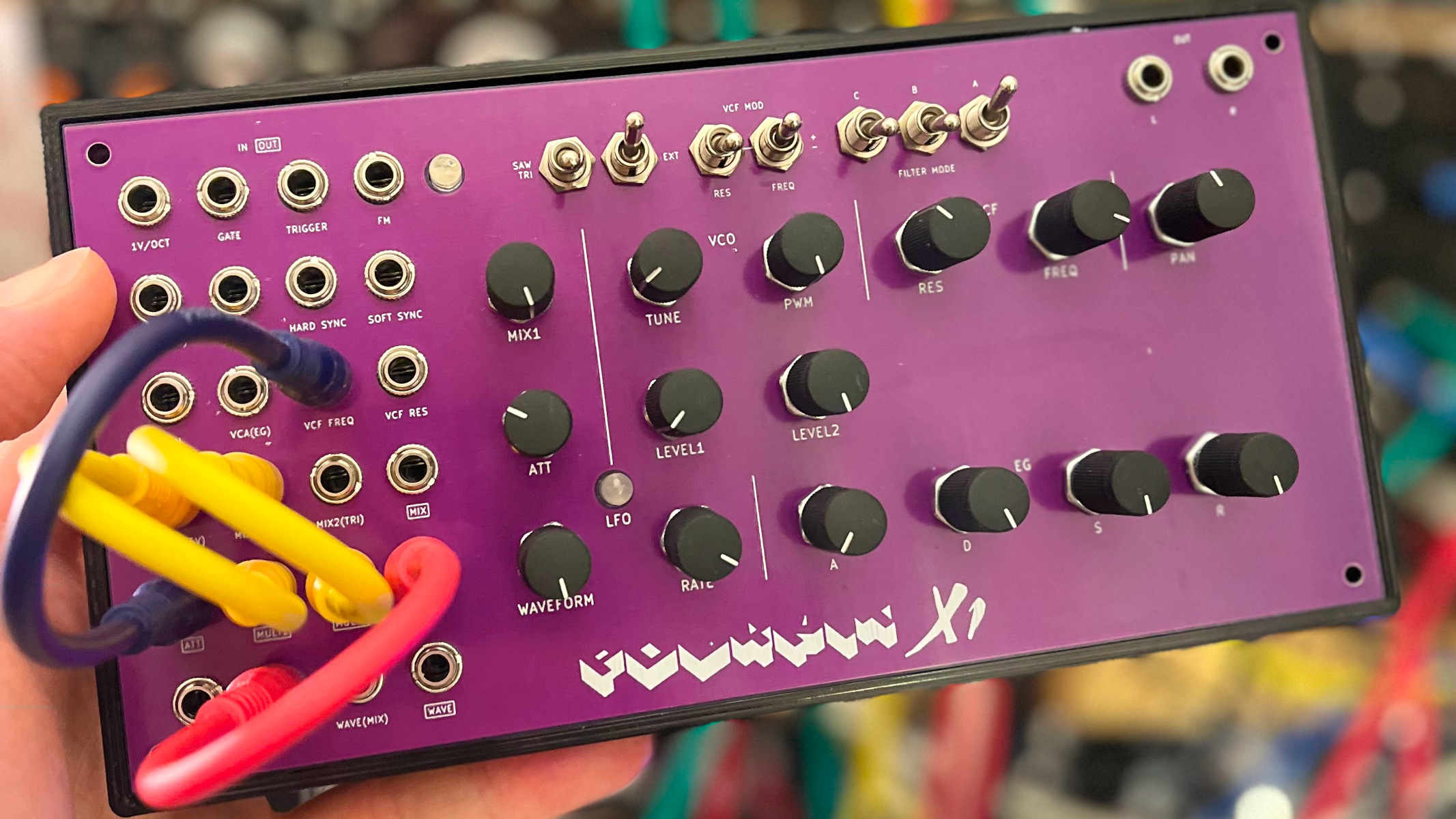
An analog, semi-modular, patchable synthesizer you can build yourself
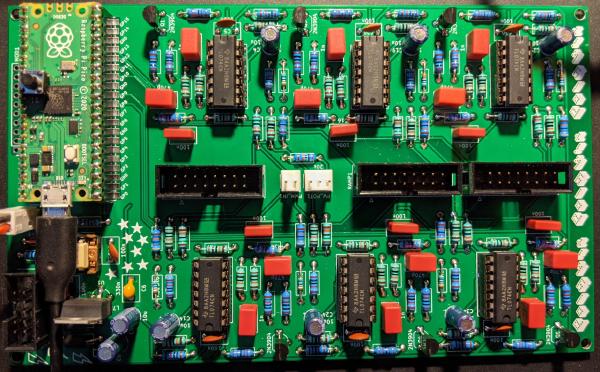
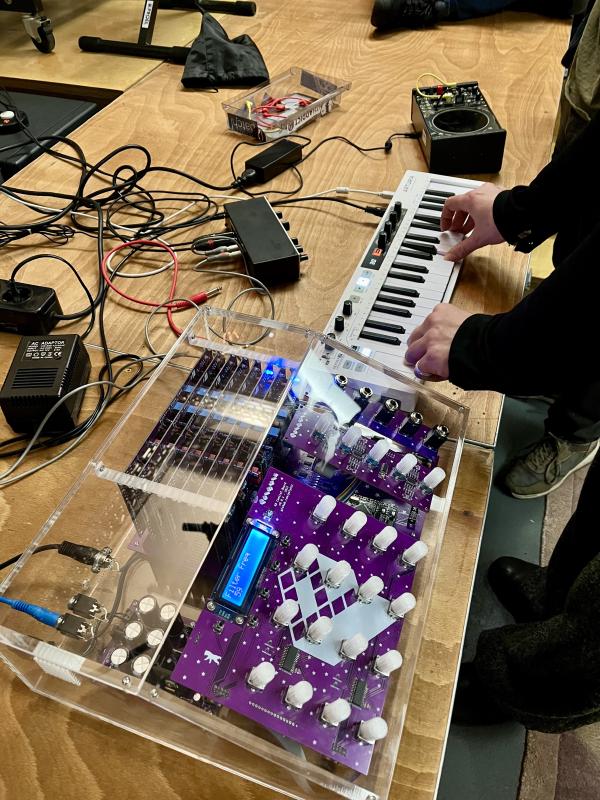
The Polykit X1 is a DIY semi-modular synthesizer that pairs a single Polykit-X voice card with a dedicated interface board: LFO, wave folder, mixer, attenuators, buffered multiple, offset voltages, and power supply. Everything is fully open source—schematics, KiCad PCB layout, front panel, and a 3D-printable case. It is designed to work with the same voice card used in the polyphonic synthesizer project.
Overview#
- Semi-modular, patchable – 3.5 mm jacks throughout for CV, gate, and audio
- One voice card – VCO (saw, triangle, pulse), ADSR, multimode filter (8 responses), external input, stereo panning
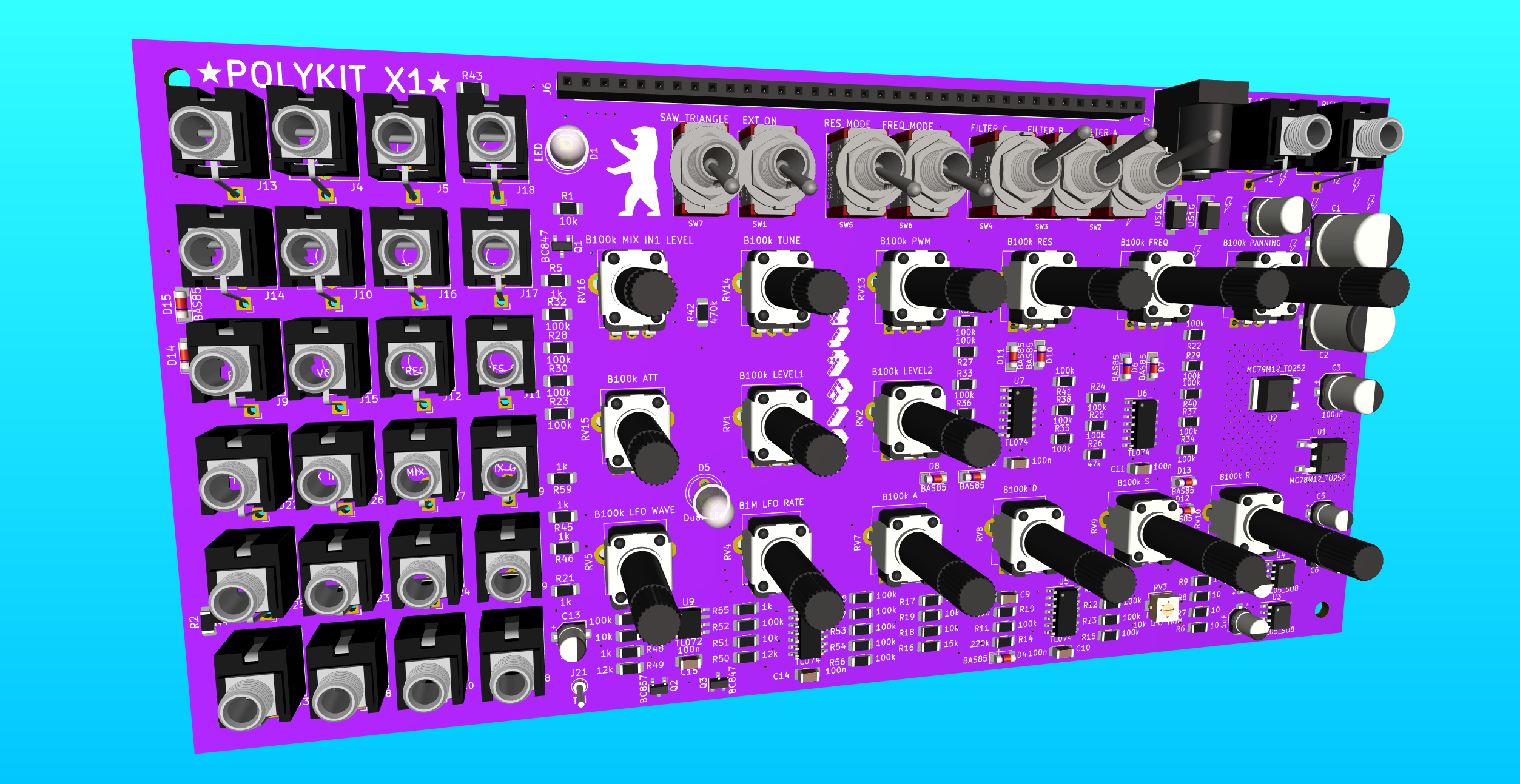
- Interface board – LFO, wave folder, 2‑channel mixer, attenuator, buffered multiple, offset voltages, ±12 V / ±5 V PSU
- Open source – KiCad schematics and PCB, Gerbers, front panel files, STL for case
- 12 V AC wall-wart powered (e.g. 12 V AC/AC 1 A)
Voice card (Polykit-X)#
The sound engine is the Polykit-X voice card: one PCB that carries a full analog voice. It is the same design used in the 8‑voice polyphonic synth; here it is used once and patched via the front panel.
Voice card specs#
- VCO – Saw, triangle, and pulse; 1 V/oct pitch CV, FM, PWM, hard and soft sync
- Envelope – One ADSR; output and CV inputs for A, D, S, R; gate and trigger inputs
- Multimode filter – Pole-mixing VCF with 8 filter responses: 4P LP, 2P LP, 4P HP, 2P HP, 4P BP, 2P BP, 3P AP + 1P LP, 4P N (based on pole-mixing principles as in classic Oberheim-style filters)
- VCAs – Internal VCAs for blending, main VCA for the envelope, panning VCA for stereo out
- External input – Audio in that can be mixed with the oscillator
- Output – Stereo (left/right) with panning CV
The voice card connects to the interface board via a 36‑pin header. Pinout, BOM, and tuning steps are documented in the voice card repository.
Semi-modular interface#
The X1 interface board adds everything needed around the voice card to make a playable monosynth:
| Block | Description |
|---|---|
| LFO | Triangle–pulse blend; rate and waveform CV; LFO output jack |
| Wave folder | Waveshaping (based on CGS52); wave in / wave out jacks |
| Mixer | Two channels; one input has level control; default input for channel 2 when unpatched |
| Attenuator | Single attenuator with +5 V normalled on input |
| Multiple | Buffered multiple (1 in, 2 out) |
| Offsets | Fixed offset voltages for modulation |
| Power supply | On-board PSU: 12 V AC in (barrel jack), ±12 V and ±5 V for the voice card and circuitry |
Front panel brings all voice card and interface I/Os to 3.5 mm jacks: pitch CV (1 V/oct), gate, trigger, FM, PWM, sync, filter CV, resonance CV, ADSR out, LFO, pan CV, external in, mixer in/out, multiple, and stereo out.
Build and files#
- Schematics
- Gerber files
- Front panel
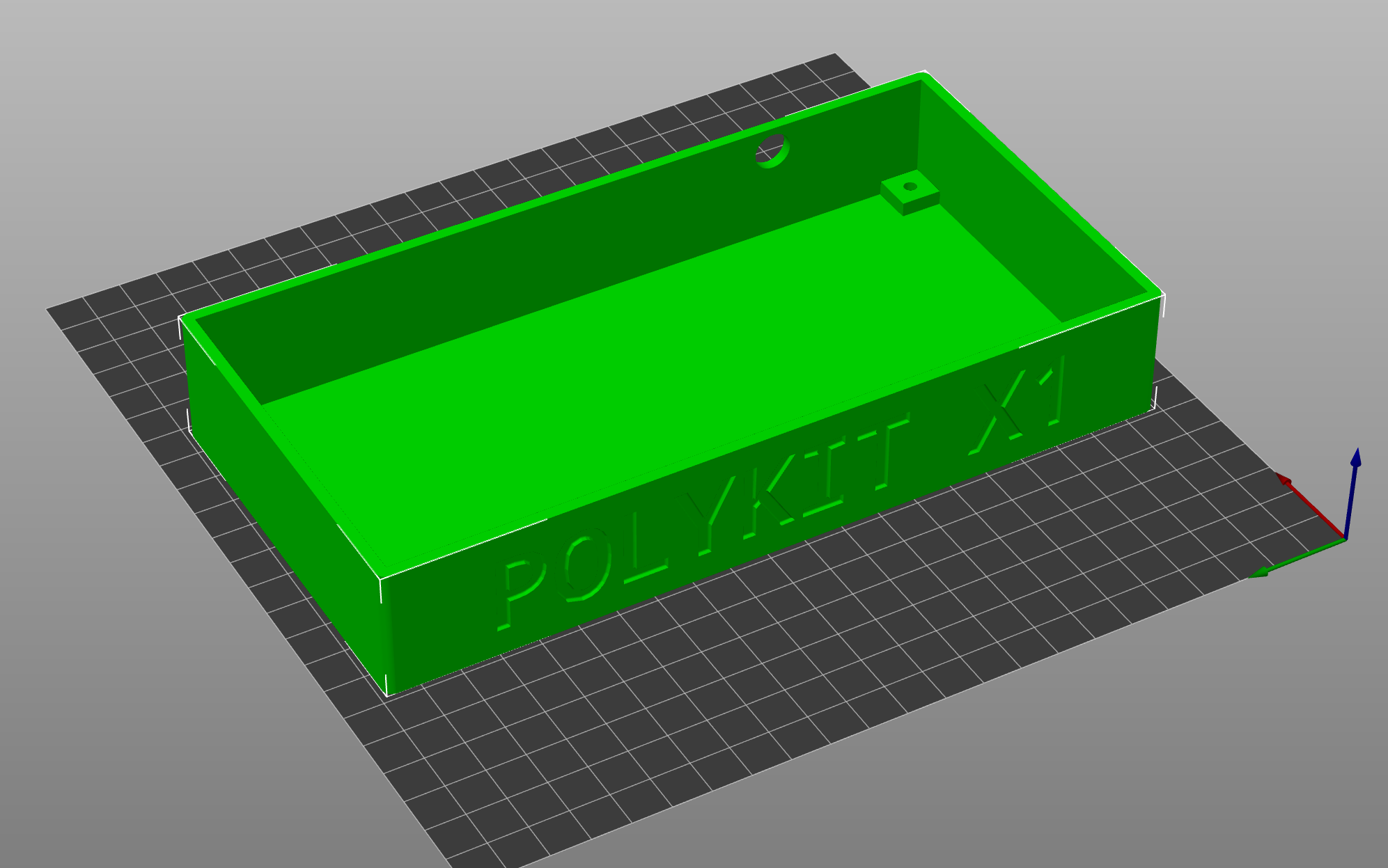
- Case – 3D-printable STL files in the stl directory; 12 V AC barrel jack and jack cutouts as per design.
A full bill of materials (BOM) is in the polykit-x-monosynth README; it lists all passives, op-amps (TL074, TL072), regulators (78M12, 79M12, 78L05, 79L05), transistors, diodes, pots, switches, and Thonkiconn-style 3.5 mm jacks.
Tuning#
Tuning follows the voice card tuning procedure (VCO scale and trim). You need a 1 V/oct source (keyboard or fixed voltages), a tuner or tuning app, and dupont cables to reach the trimpots. Minimal set of connections: ground, all four rails (+12 V, −12 V, +5 V, −5 V), PITCH, PWM, ADSR outputs, GATE, LVL2, FREQ_CV, and audio outputs.
Modifications#
The README suggests adding the VCO saw output into the mixer’s default input (e.g. mix channel 2) via a 1 kΩ resistor, by tapping the signal between R1 and U6 pin 8 on the voice card.
Videos#
How I built a PATCHABLE ANALOG SYNTH from scratch on MakerTube
Resources#
- polykit-x-monosynth – X1 interface schematics, PCB, front panel, case STL, BOM
- polykit-x-voice-card – Voice card schematics, PCB, pinout, BOM, tuning
- Polykit KiCad footprints – Footprint library used in the design
- Pole-mixing filters (Electric Druid) – Background on the filter topology
- Open-source 8-voice polyphonic synthesizer – Same voice card in a polyphonic build
- Wavefolder CGS52